
Published December 18, 2025
A Day in Hibbing: Exploring Minnesota's Iron Range Hometown
Tucked into north–central Minnesota on the Mesabi Iron Range, Hibbing is a town shaped by iron, history, and resilience. Known as "The Town That Moved," "The Grand Canyon of the North," and the "Iron Ore Capital of the World," Hibbing has long stood at the center of Minnesota's mining heritage.
The town was founded in 1893 by Frank Hibbing, who famously declared, "I believe there is iron under me. My bones feel rusty and chilly." His instinct proved correct. What followed was one of the most remarkable iron ore booms in American history — a legacy that still defines the region today.
Spend a day in Hibbing and reminders of that history appear everywhere — from towering mine overlooks to century-old buildings that tell the story of a town literally moved to make way for the ore beneath it.
Start the Day at Sunrise Bakery
A perfect morning in Hibbing begins at Sunrise Bakery, a beloved institution that has been serving locals for more than 100 years. Inside the shop's glass cases sit generations of Iron Range favorites: banana flips, powdered sugar–covered snowballs, and raspberry Bismarcks filled with sweet jam.
Before leaving, grab a loaf of potica to take home. This traditional walnut-filled rolled bread reflects the Eastern European heritage of many of the miners who settled the Iron Range generations ago.
A Town That Moved
From Sunrise Bakery, take a short drive toward Historic North Hibbing. Along the way, the Greyhound Bus Museum makes an interesting stop — especially for families. While the town no longer has Greyhound service, Hibbing is where the first Greyhound bus line began in 1914.
North Hibbing itself may look quiet at first glance, but it tells one of the most unusual stories in Minnesota history. In the early 1920s, as iron deposits beneath the town proved increasingly valuable, the decision was made to relocate the community entirely. More than 180 homes and 20 businesses were moved several miles south at a cost of $16 million so the mine could expand.
Today only a small portion of the original town remains, with foundations, steps, and historic markers scattered across a four-block area. The space has been reimagined as a park where visitors can explore the remnants of the past while enjoying modern additions like a frisbee golf course, dog park, and model airplane airfield. A few first-come, first-served campsites sit quietly among the century-old foundations.
Overlooking the Grand Canyon of the North
No visit to Hibbing is complete without seeing the mine itself.
The Hull–Rust–Mahoning Mine View offers sweeping vistas of what many call the "Grand Canyon of the North." Stretching roughly 3.5 miles long, 1.5 miles wide, and plunging more than 500 feet deep, the open pit mine is staggering in scale. Since 1895, more than 800 million tons of iron ore have been pulled from this massive excavation.
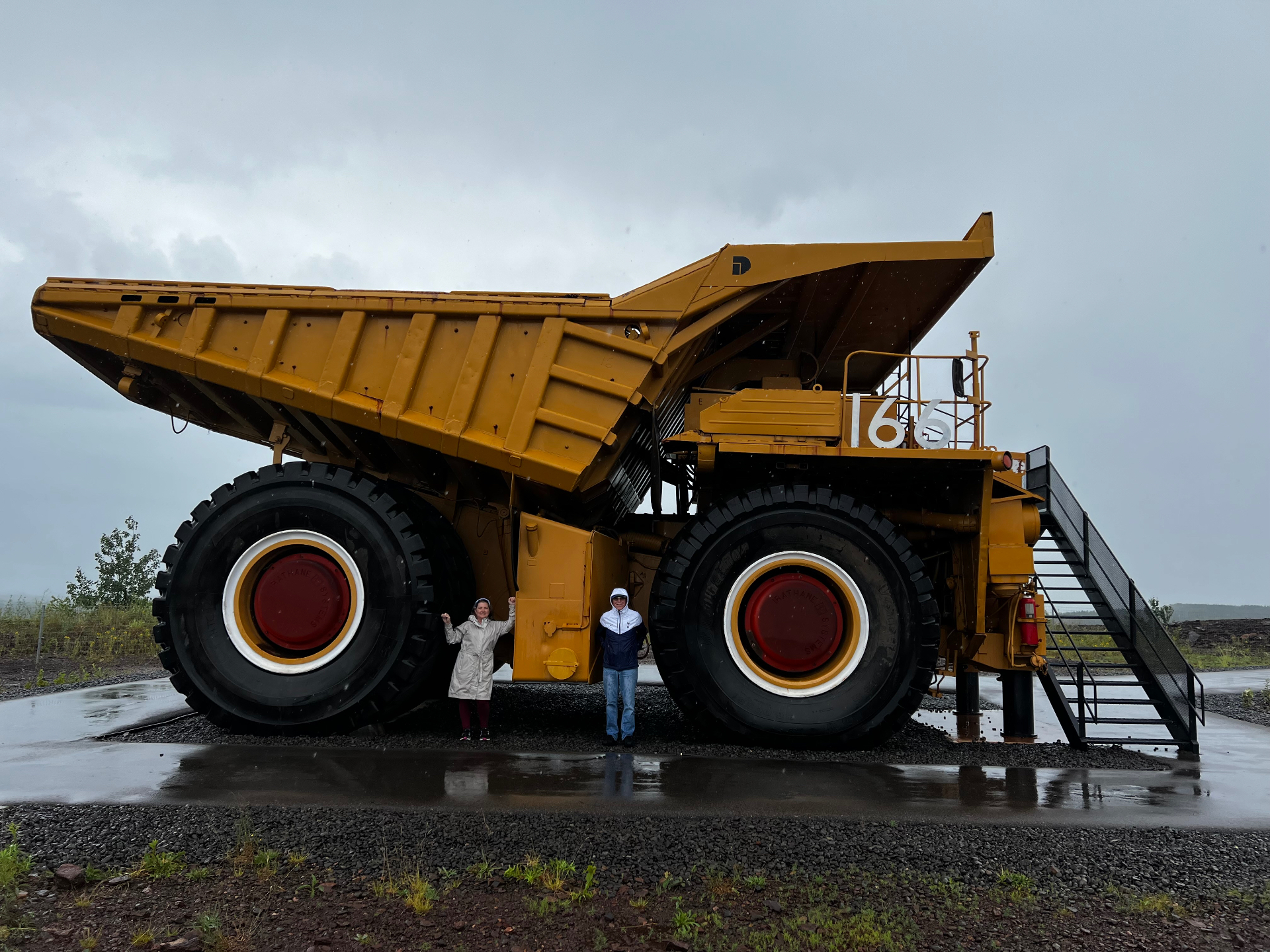
From the overlook, the enormous haul trucks appear almost toy-like as they crawl along the terraced pit walls. Up close, however, the scale becomes clear — the trucks' tires alone are taller than most vehicles on the highway. Visitors can explore exhibits, walk among historic mining equipment, and even climb into the driver's seat of one of the giant machines that still power the Iron Range economy.
Lunch in a Building Full of History
After a morning exploring Hibbing's industrial past, head back into town for lunch at BoomTown Brewery & Woodfire Grill.
The building itself has lived several lives. It was once the western terminal and power plant for the Mesabi Interurban Railway, which ran electric trolley cars across the Iron Range. When the railway shut down, the building became a full-service gas station before eventually transforming into The Atrium restaurant in the 1980s. Later it became Zimmy's — a tribute to Hibbing native Bob Dylan.
Today BoomTown Brewery has added yet another chapter, bringing craft brewing to the historic structure. Local favorites like Dirty Ore Nitro and Hat Trick Honey Amber pair well with a hearty menu. The Boom Boom Pulled Pork Tacos and Cranberry Pecan Chicken are standouts.
Bob Dylan and the Castle in the Woods
Just a short drive from the brewery sits 2425 Seventh Avenue, the childhood home of Bob Dylan. The modest house was purchased by longtime fans who now maintain it as a small museum filled with memorabilia.
A few blocks away stands one of the most surprising landmarks in northern Minnesota: Hibbing High School.
Built in 1920 at a cost of $3.9 million — more than $50 million in today's dollars — the school was designed to be nothing less than "The Castle in the Woods." Inside are marble staircases, hand-painted murals and frescoes, ornate cut-glass chandeliers imported from Czechoslovakia, and a grand theater modeled after the Old Capitol Theater in New York City. The auditorium still houses a rare 144-pipe Barton Vaudeville organ.
It may be a high school, but it feels more like a historic opera house.
Outdoor Adventure in Every Season
Beyond its history, Hibbing also serves as a gateway to outdoor adventure.
Cyclists visiting in summer can hop onto the Mesabi Trail, one of Minnesota's longest paved bike routes. The trail winds through forests, lakes, streams, and small Iron Range communities from Grand Rapids to Ely. Hibbing sits near the midpoint, making it an ideal place to start a ride. Some travelers even turn the journey into a lodge-to-lodge cycling trip, with luggage shuttled ahead while they simply enjoy the ride.
Winter brings a different kind of energy. Local skating rinks fill with pickup hockey games, while the curling club hosts regular practices and matches. Beyond town, thousands of miles of snowmobile trails and cross-country ski routes weave through the forests of northern Minnesota.
A Town Shaped by Iron
Hibbing may be small, but it carries an outsized history. It's a place where entire neighborhoods moved to follow the ore beneath them, where towering mine pits stretch toward the horizon, and where generations of miners built communities that still thrive today.
For visitors willing to venture onto the Iron Range, Hibbing offers something rare: a town where industry, culture, and landscape all share the same story.
And for those of us who grew up here, it will always simply be home. I'm proud to be a Ranger.
Frequently Asked Questions
- Why is Hibbing called "The Town That Moved"?
- Entire neighborhoods of Hibbing were relocated so miners could reach the iron ore beneath the original town.
- What is special about Hibbing High School?
- Built in 1920 for $3.9 million, the "Castle in the Woods" features marble staircases, hand-painted murals, Czechoslovakian chandeliers and a rare Barton Vaudeville organ.
- Can you bike from Hibbing?
- Yes. Hibbing sits near the midpoint of the Mesabi Trail, a paved bike route running from Grand Rapids to Ely.
- What is there to do in Hibbing in winter?
- Winter brings pickup hockey, curling, and thousands of miles of nearby snowmobile and cross-country ski trails.